Thursday, October 27, 2011
Running With Scissors
Tuesday, September 20, 2011
21: Reading
Saturday, April 16, 2011
Crochet cats and creativity


Wednesday, February 03, 2010
A pig at breakfastime
"'No, I only distribute pigs to early risers,' said Mr Arable. 'Fern was up at daylight, trying to rid the world of injustice. As a result, she now has a pig. A small one, to be sure, but nevertheless a pig. It just shows what can happen if a person gets out of bed promptly. Let's eat!'"-- EB White, Charlotte's Web
A guilt trip, sibling comparison and preamble to a meal, all in a single short paragraph. A true master, Mr Arable.
Tuesday, January 26, 2010
The three latest books I've completed
What it's about: What do I believe, and where did it come from? Is it all a bunch of misty, unsubstantiated ideas, or as real and tangible as the ground I walk on? I'm more accustomed to reading Eric Ludy's take on relationships than on faith, so this book surprised me a little, but only in a good way.
The bottom line: If there's a feminine side to everything and everyone, as contemporary culture tells us, it follows that there's also a masculine side. Unfortunately, in our eagerness to be PC and inclusive, we've neglected the masculine side of who we are, collectively and as individuals. Ludy asks some sharp questions, and explores the answers, about how we can regain that balance without becoming mustachioed guerilla women and sissyfied metrosexual men.
Read it if: You're sick and tired of hearing the label "Christian" without seeing the Christ behind the label. He lived and died, and lives again, for a gristly as well as a glorious cause. This book reminds us to hang on to both sides of that coin.
Tender Grace, Jackina Stark
What it's about: A widow reclaims her life after spending two years buried in grief. I am a fan of good road-trip stories, and this is a great road-trip story. What's not to love? It's written as a journal, and I love journals; it isn't afraid to face the uglier, no-make-up side of faith, and I'm not afraid to face the uglier, no-make-up side of faith; it's often funny and sad in the same sentence, and I often feel funny and... you see where I'm going here.
The bottom line: Audrey hits the road in search of something that will make life worth living again. She isn't disappointed. Neither am I, each time I take the journey with her.
Read it if: You need a feel-good read, tearful catharsis, or brief descriptions of scattered tourist destinations in the American Southwest. Actually, no, if you read it for that last reason alone you'll feel let down. But don't read it for that last reason alone; trust me, just read it.
A Wedding in December, Anita Shreve
What it's about: A pair of high school sweethearts weds, a considerably long time after high school. Their old gang gathers for the wedding, except for one: he drowned back in those high school days. The book explores life, death and everything that happens in between -- love, guilt, betrayal, hope, forgiveness, fear, illness, fidelity, infidelity and more.
The bottom line: I'm not sure if there is one. The book doesn't conclude with happily ever afters for everyone involved. You get the feeling that loose ends have not been tied up and the story goes on after these pages. That's quite a refreshing difference from novels whose author believes everything must be resolved before your right index finger hits the back cover. However, I find it very hard to feel comfortable in the characters' world where marital infidelity is the norm. Sure, they struggle with it and ask profound questions about whether it's right or wrong, but go on frolicking in it without ever answering those questions. Call me prudish if you want, but it's my blog and I'll state my values if I want to.
Read it if: I don't know how to complete this. I tend to find Shreve's writing dry and in need of tightening. The plot has potential but is largely forgettable. And yet it was engaging enough to finish, so... what shall I say? Read it if you have the time and, like me, you won't have to pay too much for it. (My copy? Only a dollar at the bookshop that gave my mobile phone to a thief. Now there's a story worth telling.)
Friday, January 08, 2010
Literary liberty
Oh, the joyous prospect of being able to read something without flagging every other page with a bright-coloured sticky note.
Even more joyous, the freedom to forget what I've just read if I want to. On the positive side, the freedom to remember whatever I want without worrying that it will steal space that was needed for remembering assessed topics.
And the freedom to read as quickly as I want, without the risk of intellectual indigestion (usual symptoms: headache and a sudden loss of character recognition) from trying to summarise as I read.
Or the freedom to read as slowly as I want, savouring every word without regard for impending deadlines.
The freedom to read anything I want, simply because I want to and not because if I don't, I won't have any theory to back up my practice and my clients will end up even worse off for having come to see me.
Perhaps the greatest of this little cluster of freedoms: the freedom to not have a strong opinion on everything I read, expressed in 1,500 words, double spaced in 12pt Times Roman.
It's good to be free.
Tuesday, August 26, 2008
Giant's Bread
My first exposure to her work was through the film version of Murder on the Orient Express, during that time in the early 90s when Malaysia's RTM2 (as it was then known) must have thought that Victorian period crime movies were the choice of the people, because they showed one or two every week. I was too young at that time and I thought it was just another boring, draggy British drama. Only later did I make the acquaintance of the real Hercule Poirot between the pages of Murder in Mesopotamia and Lord Edgeware Dies, and discover the charm in his personality that only Christie's words could have brought to life.
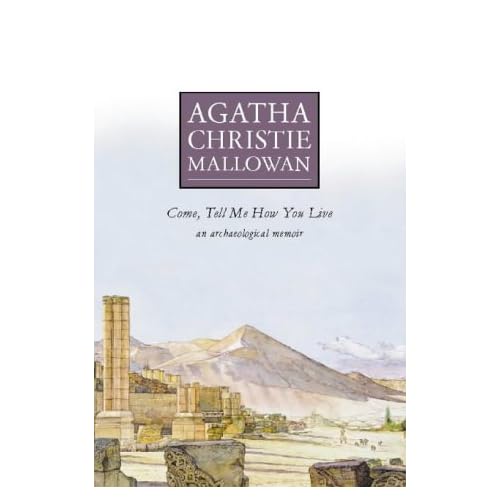
A couple of years ago, I was browsing in the bargain aisle of a popular bookshop in KL when I came across Agatha Christie's memoirs, Come, Tell Me How You Live.
Reading it is like being given access into her private journal. You get to see what her "everyday" was like, living on a Middle Eastern archaeological dig in the 30s. There is mention of violent inter-clan fights among the workers; the painful necessity of deciding which half of the discovered artefacts to surrender to the co-sponsors of the dig that makes my recurrent "Dark Chocolate Fantasy or Mango Sorbet?" quandary at the ice-cream store seem even more stupidly frivolous than it is;and pushing this book even higher up my personal rankings, there's even a cat. Not just any cat, but a professional cat.
Giant's Bread was the first of a series of non-crime novels that Christie wrote under the pen name of “Mary Westmacott”. It surprised me at almost every corner with how current and modern it was. If someone had told me it was a World War I period novel written in the past few years, I would have believed it.
I could tell you about the characters and the plot, but the weaving of the story is so intricate that if I do, I might compromise your enjoyment of the story. Trust me, this book is worth reading, even if you're “not the reading type”. You'll see how the trials and pains of growing up are practically universal, whether you're in pre-war England or '00s anywhere. You'll love her dry irreverence:
“The living don't all want exactly the same thing, so I don't see why the dead should either. There must be heaps of selfish dead – if they exist at all they must be very much the same as they were in life. They can't be full of beautiful and unselfish feelings all at once. It always makes me laugh when I see a bereaved widower tucking into his breakfast the day after the funeral and saying solemnly, 'Mary wouldn't wish me to grieve!' How does he know? Mary may be simply weeping and gnashing her teeth (astral teeth, of course) at seeing him going on as usual just as though she had never existed.”
I laughed at loud when I got to the parenthesis about astral teeth. I'm glad I read alone these days.
Anyway, I'm having a hard time returning this one to the library. It's like potato gratin on a draughty winter's day: once it's finished, you still want more.